
Romanesque churches of the Vall de Bianya: route with charm and mountain heritage
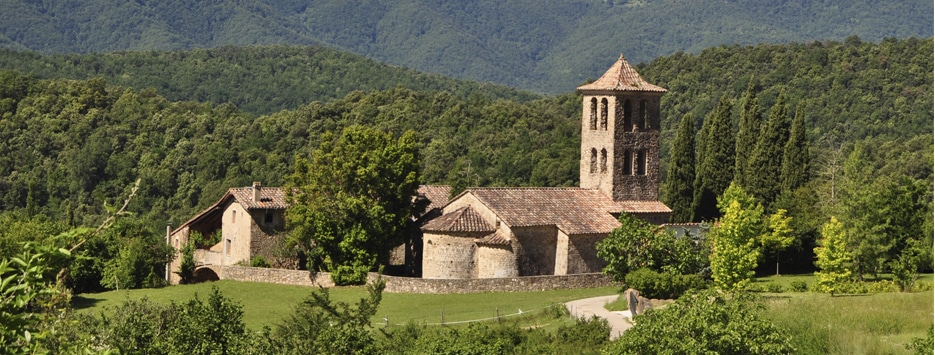
The Vall de Bianya hides a discreet treasure: a group of Romanesque churches and hermitages scattered between the plain and the valleys (such as the Vall del Bac). It is not a massified “postcard” Romanesque, but heritage integrated into the landscape: quiet paths, hills, forests and small architectural gems that appear when you least expect it.
In this article we leave you with an orientation route and a selection of outstanding churches so that you can plan your visit without haste (and without doing a thousand kilometers in one day).
Why is the Romanesque of the Vall de Bianya worth it?
Because here the experience is twofold: architecture + environment. Many churches are located on high points or in small neighborhoods, and this makes the visit an enjoyable excursion. In addition, you will find typical Romanesque elements (semicircular apse, narrow windows, portals with semicircular arches, belfry bells or towers) with details and local stories that give character to each place.
Recommended route to discover them (half day or full day)
You can replace the path block you had with this one (or add it as an extension):
Option 1: Plana de Bianya (easy access and ideal to start)
- Saint Salvador of Bianya
- Santa Margarida de Bianya (highly recommended to complete the route of the plain)
- Sant Pere Despuig (if you want to add a quick tour)
Option 2: Vall del Bac (charming landscape and hermitages)
- Sant Feliu del Bac
- Santa Maria de Sacot
- Santa Magdalena del Coll (if you want a more emotional/testimonial visit)
Option 3: Castellar de la Muntanya (rural getaway)
- Santa Maria de Castellar de la Muntanya (ideal as a “main visit” for a morning or afternoon)
- And then, if you have time left: a gastronomic stop or quiet walk through the area.
Tip: Better to make 2–4 churches per outing. It is a heritage to be enjoyed without rushing.
Essential Romanesque churches (with the “what’s special about it”)
Saint Salvador of Bianya
One of the most representative parishes in the area. It stands out for its Romanesque structure of a single nave and for interesting decorative elements in the apse. It is also a good starting point if you want to start on the plain and add visits little by little.
Why go: it’s a “round” visit and very good to put it into context.
Santa Margarita of Bianya
One of those churches that make you understand why Romanesque fits so well with this landscape. It has medieval origins and, despite having suffered the passage of time, it retains an important part of the Romanesque structure. The complex combines the simplicity of a mountain temple with elements that reveal subsequent extensions and modifications. The best: the feeling of a “living” parish church rooted in the territory.
Why go: because it is a very complete visit: heritage, pleasant location and a Romanesque that is easy to “read”.
Santa Maria de Castellar de la Muntanya
If you are looking for a visit with an air of escape, this is the perfect one. Located in a higher and rural environment, it is a church that breathes calm. Architecturally it maintains the Romanesque essence, but with traces of other periods that have been transforming the building. It is the type of hermitage that fits into a day of unhurried travel, when you feel like getting off the beaten path and having the feeling of having discovered a special corner.
Why go: because of the surroundings and because it has that “separate” Romanesque touch that makes the visit more memorable.
Sant Martí del Clot
A church with a history of reconstructions and transformations. Over time, structural changes have been made (such as the addition of side chapels and outbuildings) and there are indications that explain important reforms after complicated episodes.
Why go there: because it is a clear example of how Romanesque evolves and adapts to the passing of the centuries.
Saint Martin of Solamal
A good example of mountain Romanesque with details that make it different. The chancel has a semicircular apse and it is easy to identify ornamental elements on the outside. In addition, pieces of interest are preserved, such as the immersion baptismal font, a very characteristic element in some Romanesque temples.
Why go: to see unique details and a very pleasant location.
Sant Feliu del Bac
Located in the Vall del Bac, it is one of those churches that win for the environment: forest, slopes and the feeling of being away from the noise. Architecturally, it responds to the Romanesque scheme of a single nave with an apse to the east, and presents a combination of large windows and bell tower elements that also explain changes and stages.
Why go: because of the atmosphere and because it is a very authentic visit.
Sant Martí de Capsec
One of the most attractive Romanesque churches in the Vall de Bianya. The verticality of the bell tower and the structure of a single nave with a semicircular apse stand out. It is also interesting to understand how weather (and episodes such as earthquakes) can affect buildings and how they have been restored to recover their essence.
Why go: it is one of the most complete visits if you are interested in “textbook” Romanesque.
Saint Andrew of Socarrats
A church that combines the original Romanesque with later modifications. It retains characteristic elements such as the semicircular apse and construction details that help to “read” the different stages of the building.
Why go: because it is a good example of Romanesque with layers of history.
Santa Magdalena del Coll
A different visit: today it is a space with a more fragile air, which reminds us that heritage also needs care and maintenance. Its value is both architectural and testimonial: a place that explains devotions, local festivals and religious life in the territory.
Why go: because it excites and because it highlights the importance of preserving.
Other churches to complete the route (if you have time)
If you feel like expanding, you can add to the map of visits: Sant Andreu de Porreres, Sant Miquel del Mont, Sant Miquel de la Torre, Sant Pere Despuig, Santa Maria de Sacot or Sant Ponç d’Aulina (some are ideal if you want to walk a little and do the more “excursion” route).
Practical advice before going
- Comfortable footwear: there are often tracks and sections with irregularities.
- Less is more: it is better to visit a few churches and enjoy them well.
- Respect for the environment: many are in neighbourhoods or areas of nature; Keep quiet and take care of the space.
